Give us your track and your city. We come back with your preceptor path, free to ask and no obligation.
Building an SNHU clinical placement plan in Texas
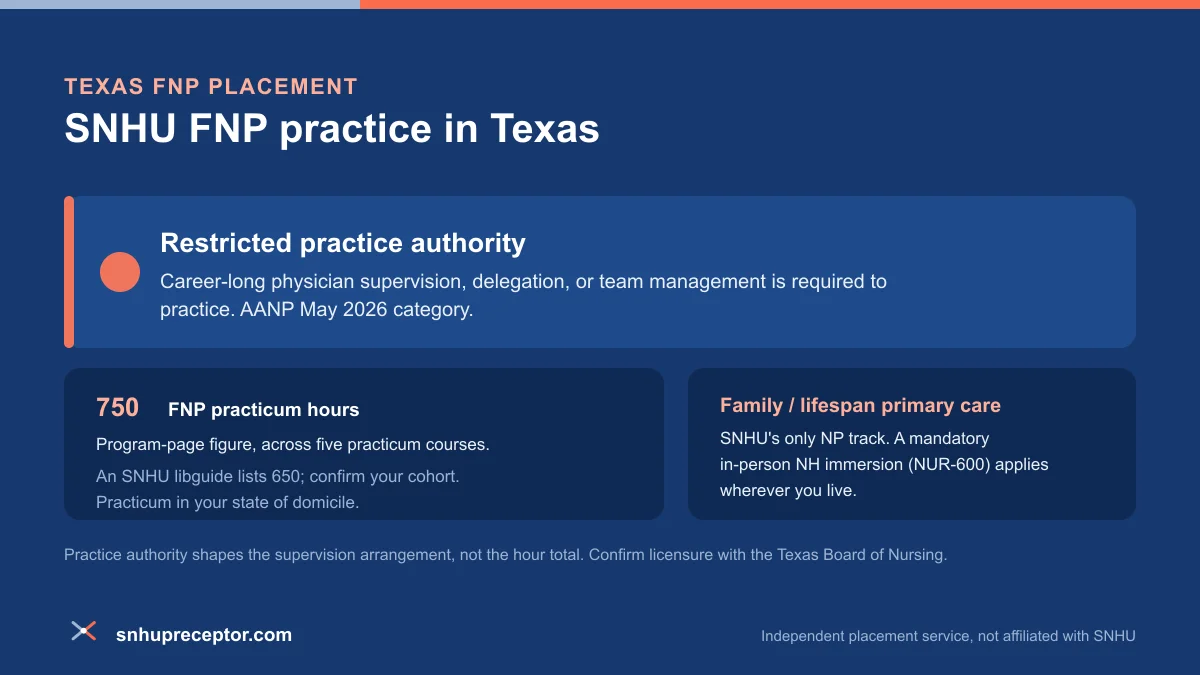
Texas is a restricted practice state under AANP's May 2026 category, and SNHU currently accepts Texas residents into its FNP track. The preceptor, site, and course still require specific approval.
Combine Texas eligibility with restricted practice facts
SNHU currently lists Texas among the states accepting FNP students. The FNP applicant identifies one potential preceptor, but that early name is not a final placement approval. The student must remain domiciled in an eligible state and complete practicum in the reported state of domicile. Confirm the clinician, patient population, practice arrangement, site, course, term, and required documents with SNHU before hours begin.
AANP classifies Texas as restricted practice. State rules restrict at least one NP practice element and require regulated career-long supervision, delegation, or team management. Check how the proposed preceptor lawfully practices within the organization. A student remains limited by approved supervision, course objectives, and site policy.
Use Texas Board APRN information
The Texas Board of Nursing provides official APRN practice information and license verification resources. Search the candidate under the legal name, confirm active RN and APRN credentials, role, population focus, and public restrictions, and document the professional relationships supporting practice.
An FNP preceptor should have family or primary care preparation and an appropriate patient panel. Non-NP MSN tracks require fit with education, quality, executive leadership, or population healthcare activities. RN-to-BSN community work may involve another supervisor type. Submit the complete role and setting, not only a license number.
Narrow the Texas search before outreach
Dallas-Fort Worth, Houston, San Antonio, and Austin have the largest clinical markets. El Paso, Lubbock, Amarillo, Abilene, Waco, Temple, Killeen, and Corpus Christi offer regional hubs. McAllen and Brownsville serve the Rio Grande Valley, while Tyler, Longview, Beaumont, Midland, and Odessa add eastern and western options.
Texas size makes a statewide request impractical. Define a metro, county, or repeatable corridor and include the course, patient or project needs, dates, and weekly schedule. Ask whether the organization centralizes student intake. Sites across a state border or involving patients elsewhere require separate review.
Plan the FNP sequence with the published total
SNHU publishes a minimum of 750 total FNP clinical hours under preceptors across five courses. Use that total for long-range planning, but confirm each course directly and avoid contradictory course arithmetic. Screen a Texas site's patient population, preceptor availability, and capacity for the current term rather than assuming it fits every course.
Each non-NP MSN track publishes 135 practicum hours. RN-to-BSN includes community clinical practice experiences without one fixed total for every student. SNHU has no DNP. The FNP preceptor guide explains the main sourcing considerations.
Plan the immersion and site onboarding early
Texas FNP students must account for the required in-person New Hampshire immersion separately from their local in-person clinical hours. Put both on the academic calendar along with employment, travel, and onboarding deadlines. The immersion does not substitute for a Texas practicum.
Ask each site about agreements, internal applications, compliance records, training, and lead time. Large systems may make decisions through an education office rather than the proposed preceptor. Maintain a backup until all approvals are complete.
Treat virtual activity as a conditional proposal
SNHU does not publish a blanket telehealth allowance or named clinical tracking system. Official clinical language describes hours at an in-person location, so physical attendance is the planning baseline.
We source physical placements and can review a virtual-capable proposal conditionally only after written permission from SNHU, the course, the site, and all states connected to patient and clinician location. Confirm privacy, supervision, authority, and countable activity before scheduling.
Bring a complete Texas request
We can research Texas prospects, conduct outreach, check public credentials, and organize candidate information for review. Students see the proposed match before payment and pay only when placement is secured. School and organization decisions remain required.
Trusted by nursing students and working nurses. Begin early in crowded metros and maintain a second corridor where possible. Placement pricing stays on the cost page.
Share the track, course, metro, dates, schedule, travel range, patient needs, and format preference in a free placement review. We will assess the search and approval requirements.
Create a Texas candidate file that systems can review
Use the preceptor's legal name, Texas license details, exact facility address, department, course, and term consistently. Ask whether the organization needs a school agreement, central application, compliance records, training, or its own deadline. In a large system, an individual preceptor may support the student while an education office controls access.
For FNP, confirm the real family or primary care patient mix and the preceptor's schedule for the course. For other nursing tracks, verify access to education, quality, leadership, population, or community activities in the syllabus. Maintain a second Texas prospect until onboarding is complete.
Good to know
Is Texas a restricted practice state?
Yes. AANP lists Texas as restricted practice. Verify the proposed NP's license, role, and required professional arrangement.
Does SNHU accept Texas FNP students?
Yes. Texas is on the current accepting-state list, subject to current admissions, course, site, and preceptor requirements.
How many total FNP hours does SNHU publish?
The current SNHU FNP curriculum publishes a minimum of 750 clinical hours completed with preceptors across five courses.
Can one Texas site cover every FNP course?
Possibly, but never assume it. Patient population, course objectives, capacity, and approval must be checked for each term.
Line up your preceptor, not your excuses
Tell us your track, your city, and your start timeline. We will come back with a placement plan and a realistic path to your preceptor, your cleared site, and your practicum hours.