Give us your track and your city. We come back with your preceptor path, free to ask and no obligation.
SNHU MSN Clinical and Practicum Hour Requirements
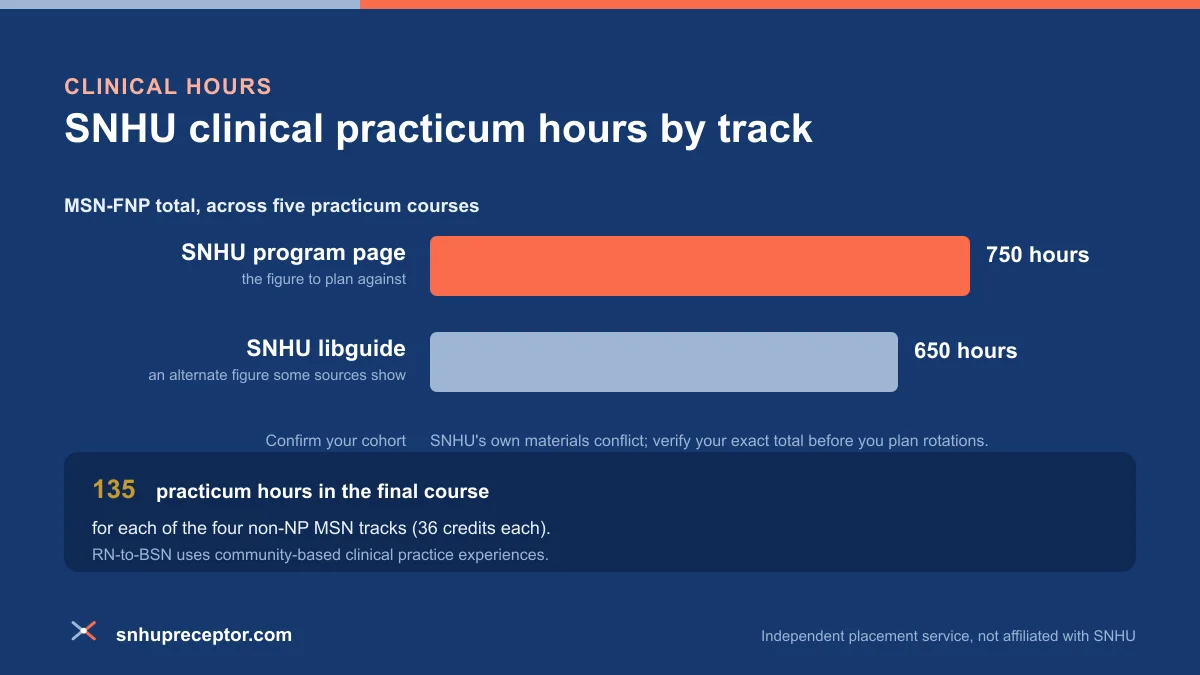
SNHU's MSN-FNP track requires 750 clinical practicum hours spread across five practicum courses, and each of the four other MSN tracks requires 135 practicum hours in its final course. Every one of these tracks expects you to work under the guidance of a preceptor you source yourself. Below is a plain breakdown of the hours by track, with the FNP figure hedged against SNHU's own materials.
How many clinical hours does the SNHU MSN-FNP require?
The MSN-FNP requires 750 clinical practicum hours per SNHU's program page, delivered across five practicum courses. The distribution is 135 + 135 + 135 + 135 + 110, which totals 750. The program overall runs 51 credits across 17 courses.
One caution on the number: confirm your exact total against current SNHU materials. An SNHU libguide cites 650 hours, so the figure you see can vary by source. Treat 750 as the program-page figure and verify against the materials that apply to your cohort before you plan your rotations.
The FNP track is SNHU's only nurse practitioner program. There is no PMHNP, no other NP specialty, and no DNP. It requires 2 years of full-time RN experience, is available in about 17 states, and leads to certification through AANPCB or ANCC.
How are the FNP practicum hours split across courses?
The 750 hours are not taken all at once. They are distributed across five separate practicum courses so your clinical experience builds over the program. The table below shows the per-course breakdown as published on SNHU's program page.
| Practicum course | Clinical hours |
|---|---|
| Practicum 1 | 135 |
| Practicum 2 | 135 |
| Practicum 3 | 135 |
| Practicum 4 | 135 |
| Practicum 5 | 110 |
| Total | 750 |
Again, confirm this total against current SNHU materials, since an SNHU libguide lists 650. The five-course structure means you may need a preceptor and site verified more than once over the length of the degree.
How many hours do the other SNHU MSN tracks require?
Each of the four non-FNP MSN tracks requires 135 clinical practicum hours, completed under the guidance of preceptors in the final course. All four are 36 credits. Like the FNP, they require you to self-source your preceptor.
The four tracks are:
- Nursing Education, 36 credits, 135 practicum hours
- Healthcare Quality and Safety, 36 credits, 135 practicum hours
- Nurse Executive Leadership, 36 credits, 135 practicum hours
- Population Healthcare, 36 credits, 135 practicum hours
| MSN track | Credits | Practicum hours | NP track? |
|---|---|---|---|
| Family Nurse Practitioner (FNP) | 51 | 750 (135x4 + 110) | Yes |
| Nursing Education | 36 | 135 | No |
| Healthcare Quality and Safety | 36 | 135 | No |
| Nurse Executive Leadership | 36 | 135 | No |
| Population Healthcare | 36 | 135 | No |
What about RN-to-BSN and the post-master's certificates?
SNHU also offers an online RN-to-BSN with community-based clinical practice experiences, and two post-master's certificates in Healthcare Quality and Safety and in Nursing Education. None of these are NP programs.
For context on what SNHU does not offer: there is no PMHNP, no additional NP specialty, no DNP, and no ADN. The FNP is the single NP pathway, which is why our preceptor sourcing focuses on it while still supporting the practicum needs of the other MSN tracks.
Why must your hours satisfy certification rules, not just SNHU?
Your FNP practicum hours are not only an SNHU requirement; they feed the eligibility rules of the body that certifies you. Both AANPCB and ANCC require FNP candidates to graduate from a program accredited by CCNE or ACEN and to complete a minimum of 500 faculty-supervised clinical hours. SNHU is CCNE accredited and its 750-hour sequence clears that floor with room to spare, but only if each rotation is supervised by a qualified preceptor and documented properly. That is why the preceptor you source matters as much as the number of hours: an unqualified or unverifiable preceptor can put those hours at risk.
National standards shape what the hours should cover, too. The AACN Essentials define the competencies graduate nursing programs are built around, and the NCSBN APRN Consensus Model sets the licensure and certification framework every state board works from. When we source and verify a preceptor, we check that the clinician fits your program and course so the hours you log count toward both your degree and your certification eligibility. Confirm your exact total against current SNHU materials for your cohort, then plan each practicum course as its own placement so a missing preceptor never stalls a term.
How do the hours translate into a placement plan?
The hour totals matter most when you turn them into a schedule. Because the FNP spreads its 750 hours across five separate practicum courses, you may need a verified preceptor and site more than once over the degree, and each course is best treated as its own placement with its own lead time. The four non-NP MSN tracks are simpler on this front: a single 135-hour practicum in the final course means one placement to arrange, though it should still be secured early because a specialization-aligned preceptor can be scarce in some regions.
Whichever track you are in, confirm your exact required total against current SNHU materials for your cohort before you build the plan, since the number drives how many placements you line up. SNHU's master's nursing program is accredited by the Commission on Collegiate Nursing Education (CCNE) and its curriculum aligns with the AACN Essentials, the national competency framework graduate nursing programs are built around. For FNP students, the certification boards add their own floor: the American Nurses Credentialing Center requires at least 500 faculty-supervised clinical hours plus three graduate APRN core courses before you can sit for the FNP-BC exam, and the American Academy of Nurse Practitioners Certification Board administers the FNP-C exam that CCNE-accredited graduates are eligible for. A preceptor who genuinely fits your course is what turns logged hours into hours that count toward both your degree and, for FNP students, certification eligibility.
Good to know
Is the SNHU FNP really 750 clinical hours?
750 is the figure on SNHU's program page (135 + 135 + 135 + 135 + 110). Confirm your exact total against current SNHU materials, because an SNHU libguide cites 650 hours.
How many hours do the non-FNP MSN tracks need?
Each of the four other MSN tracks (Nursing Education, Healthcare Quality and Safety, Nurse Executive Leadership, Population Healthcare) requires 135 clinical practicum hours in the final course, under preceptor guidance.
Does SNHU assign me a preceptor for these hours?
No. SNHU expects you to self-source your preceptor for every practicum-bearing track and gives no placement guarantee. Our service sources and verifies a qualified, SNHU-approvable preceptor for you.
How many credits is the SNHU MSN-FNP?
The MSN-FNP is 51 credits across 17 courses, including five practicum courses. It also requires 2 years of full-time RN experience and a mandatory in-person New Hampshire immersion.
Line up your preceptor, not your excuses
Tell us your track, your city, and your start timeline. We will come back with a placement plan and a realistic path to your preceptor, your cleared site, and your practicum hours.