Give us your track and your city. We come back with your preceptor path, free to ask and no obligation.
What does SNHU preceptor placement cost?
SNHU preceptor placement through our independent service runs 1,500 to 2,500 dollars per rotation, and you pay when matched. SNHU itself does not place NP or MSN students; it requires you to self-source your own preceptor and gives no placement guarantee, which is why a placement service exists at all. This page breaks down what the fee covers, what it does not, and the cost of leaving a practicum unsecured.
How much does an FNP preceptor matching service cost for SNHU students?
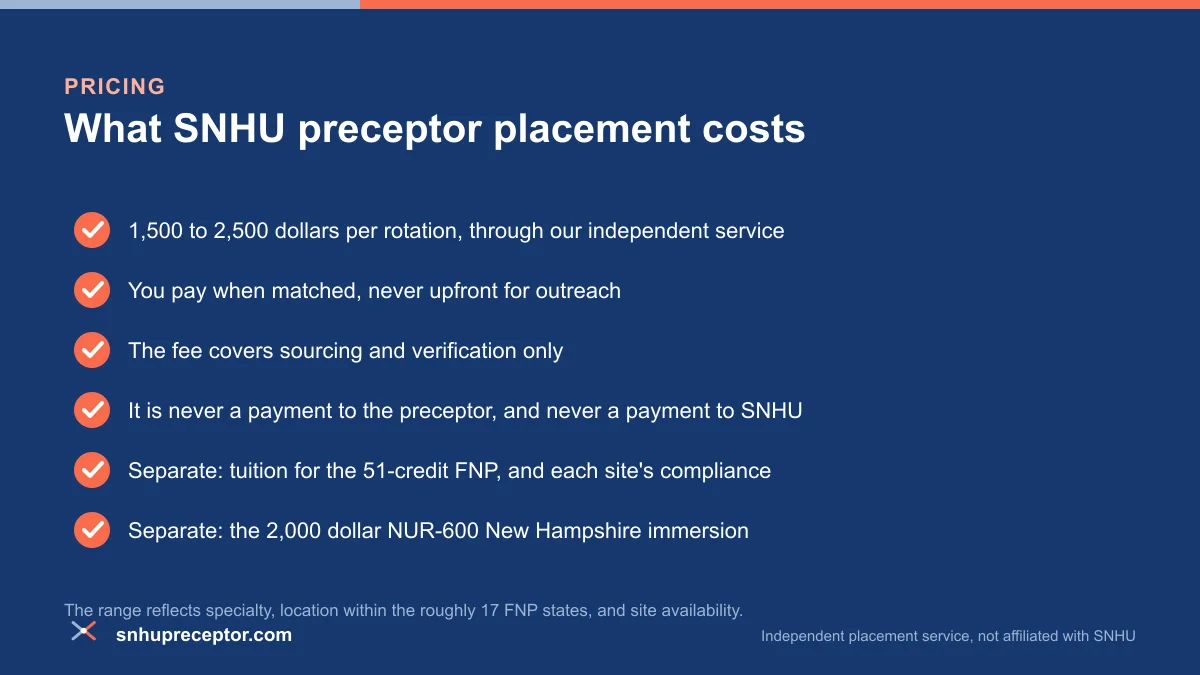
An independent FNP preceptor matching service for SNHU students runs 1,500 to 2,500 dollars per rotation, and you pay when matched.
The range reflects how hard a given rotation is to source: specialty, location within the roughly 17 states where the MSN FNP is available, and site availability all move the number. You are not charged upfront for outreach. The fee is due once we have matched you with a qualified, SNHU-approvable preceptor and site.
For context on scope, the MSN FNP requires 750 clinical practicum hours across five practicum courses (135 + 135 + 135 + 135 + 110). Hours are 750 per SNHU's program page; confirm your exact total against current SNHU materials, as an SNHU libguide lists 650. Each of those practicum courses can be its own rotation to source.
What does the fee cover?
The fee covers sourcing and verification: finding a qualified, SNHU-approvable preceptor and clinical site and getting you practicum-ready.
Concretely, that means:
- Sourcing the preceptor and site through direct outreach.
- Verifying that the clinician's credentials fit your program and course.
- Coordinating the site so you are ready to begin your practicum.
It does not cover paying the preceptor, and it is not a payment to SNHU. We are independent and do not represent the university or guarantee anything on its behalf.
What costs are separate from placement?
Placement is one line item. Several SNHU program costs sit outside our fee and are yours regardless of how you source your preceptor.
- Tuition for the 51-credit, 17-course MSN FNP.
- New Hampshire immersion (NUR-600), a mandatory in-person requirement that costs 2,000 dollars on top of tuition.
- Compliance, since each clinical site sets its own background check and immunization requirements and SNHU names no vendor.
- Malpractice insurance, which students must carry themselves.
Knowing these upfront keeps the placement fee in proportion. It is one part of a larger program budget, not the whole of it.
Why does paying when matched matter?
Paying when matched means you carry no risk during the uncertain part, the search itself.
Self-sourcing is unpredictable: a provider says yes, then a site's compliance step stalls, then the term start slips. Because you pay only once you are actually matched with an SNHU-approvable preceptor and site, the fee lines up with a result rather than with effort or hope. If we do not match you, you do not owe the placement fee.
What is the cost of a delayed practicum?
A delayed practicum usually costs more than placement itself, because an empty preceptor slot can push a whole term.
The MSN FNP runs its 750 hours across five sequential practicum courses. If you cannot secure a preceptor when a course is scheduled to begin, that course waits, and a waiting course commonly delays the ones after it. The knock-on effects add up:
- Extra terms mean more tuition against the same degree.
- A later graduation pushes back AANPCB or ANCC certification and the income of practicing as an FNP.
- Lost momentum if a verbally agreed preceptor falls through and you restart the search cold.
Weighed against a term of delayed tuition and delayed FNP income, a 1,500 to 2,500 dollar placement fee, paid only when matched, is meant to keep your practicum sequence on schedule.
How does paying a service compare to sourcing a preceptor yourself?
Self-sourcing looks free, but it carries real costs that never appear on an invoice. The most common is time: cold-calling clinics and chasing providers between classes can run for weeks, and every unanswered request is time your practicum start slips. There is also risk. A verbally agreed preceptor can fall through after a site's compliance step stalls, and if that happens close to a term start, you may restart the search from zero.
Then there are the eligibility stakes. Your FNP hours have to be supervised by a qualified preceptor and earned in a CCNE-accredited program to count toward certification through AANPCB or ANCC, so an unverified preceptor is not a shortcut. Our fee, 1,500 to 2,500 dollars per rotation and due only when matched, buys the outreach, the verification, and the coordination, so those risks are ours to manage rather than yours. Weighed against a delayed term of tuition and delayed FNP income, the trade is about protecting your timeline, not just saving effort.
What are the full cost components for an SNHU FNP student?
Placement is one line item among several. The table below gathers the costs discussed above so you can see the placement fee in the context of the whole program, from the mandatory New Hampshire immersion to the compliance and insurance you carry yourself.
| Cost item | Amount | Paid to | Timing |
|---|---|---|---|
| Placement fee (our service) | 1,500 to 2,500 per rotation | Independent service | When matched |
| New Hampshire immersion (NUR-600) | 2,000 on top of tuition | SNHU | Program requirement |
| Malpractice insurance | Student-carried | Your insurer | Before practicum |
| Site compliance (background, immunization) | Varies by site | Clinical site | Before start |
Figures reflect SNHU's published program requirements and typical market placement pricing; confirm current amounts against your SNHU materials.
Good to know
How much is SNHU preceptor placement?
1,500 to 2,500 dollars per rotation through our independent service, and you pay when matched.
Does the fee pay the preceptor?
No. The fee covers our sourcing and verification work. It does not pay the preceptor and it is not a payment to SNHU.
When do I pay?
You pay when matched. If we do not match you with a qualified, SNHU-approvable preceptor and site, you do not owe the placement fee.
Are there SNHU costs beyond placement?
Yes. Tuition, the mandatory New Hampshire immersion (NUR-600) at 2,000 dollars on top of tuition, site compliance, and your own malpractice insurance are all separate.
Line up your preceptor, not your excuses
Tell us your track, your city, and your start timeline. We will come back with a placement plan and a realistic path to your preceptor, your cleared site, and your practicum hours.