Give us your track and your city. We come back with your preceptor path, free to ask and no obligation.
SNHU RN-to-BSN Community Field Experience Placement
SNHU's RN-to-BSN is an online, non-NP program that includes community-based clinical practice experiences. As with SNHU's graduate nursing tracks, students are expected to arrange their own field experience rather than have the university place them. This page explains SNHU's RN-to-BSN field experience model and how we support it.
What kind of clinical experience does SNHU's RN-to-BSN include?
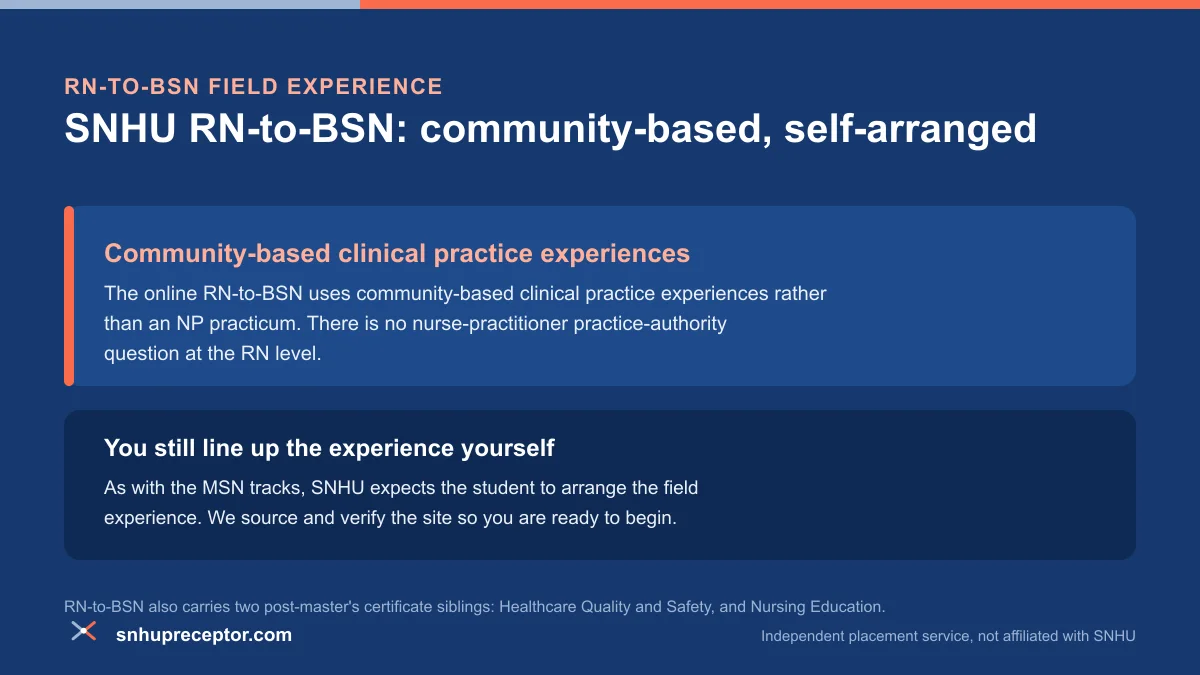
SNHU's RN-to-BSN is delivered online and includes community-based clinical practice experiences rather than traditional hospital rotations.
These field experiences are designed for practicing RNs completing their bachelor's degree, and they typically take place in community settings relevant to the coursework.
Because the program is non-NP and community-based, the placement need differs from an NP practicum, but the same self-sourcing reality applies: SNHU does not place you and offers no placement guarantee.
Does SNHU arrange the field experience site?
No. SNHU does not arrange RN-to-BSN field experience sites and gives no placement guarantee. You are responsible for identifying and securing a suitable community site.
That means the outreach, coordination, and verification fall to you unless you use a service.
We help you meet SNHU's self-sourcing expectation; we do not speak for SNHU or guarantee academic outcomes.
Who handles compliance and insurance for the field experience?
You do. Compliance at SNHU is student-borne. Each site sets its own background check and immunization requirements, and SNHU names no vendor.
Students are also expected to carry their own malpractice insurance. Build these obligations into your planning so nothing stalls your field experience at the last minute.
When we match you with a community site, we verify it is legitimate and suitable, but you remain responsible for satisfying that site's specific background, immunization, and insurance conditions.
How does the RN-to-BSN fit into SNHU's nursing programs?
The RN-to-BSN is a non-NP, baccalaureate-level online program. SNHU's baccalaureate and master's nursing programs are accredited by CCNE, not ACEN, and the institution is accredited by NECHE.
SNHU's other nursing offerings include the MSN-FNP (its only NP track), four non-NP MSN specializations, and two post-master's certificates in Healthcare Quality and Safety and in Nursing Education.
SNHU has no PMHNP, no other NP specialty, no DNP, and no ADN. If you are continuing beyond the BSN, those are the SNHU paths available.
What does field experience placement cost?
Our fee is $1,500 to $2,500 per rotation, and you pay when you are matched.
The fee covers sourcing and verifying a suitable community site and getting you ready for your field experience. It does not cover SNHU tuition or any university charge.
We are an independent placement service. We help you satisfy SNHU's self-sourcing requirement without doing the site outreach yourself.
What does a community field experience actually involve?
A community field experience is different from an NP practicum. Instead of diagnosing and prescribing under a nurse practitioner, RN-to-BSN students apply population- and community-focused nursing in settings such as public health departments, community organizations, schools, clinics, or home and workplace health programs, aligned to the specific course. The work centers on assessment, health promotion, and community-level practice rather than advanced clinical procedures. SNHU frames these as planned clinical practice experiences that let you understand, perform, and refine professional competencies at the baccalaureate level.
Those competencies follow the AACN Essentials, the national framework that defines what baccalaureate and graduate nursing graduates are expected to demonstrate, so a suitable site is one where you can genuinely meet the course objectives. Because the setting is community-based and non-NP, the person overseeing your experience is typically a qualified RN or health professional at the site rather than a nurse practitioner preceptor. When we source a community site, we confirm it is legitimate and a fit for SNHU's field experience objectives, while you satisfy that site's own background, immunization, and insurance conditions.
What should a suitable RN-to-BSN field experience site offer?
Because the RN-to-BSN field experience is community-based rather than a hospital rotation, a suitable site is one where you can meet the course objectives in a population- or community-health setting. SNHU frames these as planned clinical practice experiences that let you understand, perform, and refine professional competencies, and those competencies follow the AACN Essentials, the national framework that defines what a baccalaureate graduate should be able to demonstrate. In practice that means the site should let you do real assessment, health promotion, and community-level work, and it should have a qualified RN or health professional able to oversee you. Settings that commonly fit include public health departments, community organizations, schools, clinics, and workplace or home health programs. When we source a site, we confirm it is legitimate and aligned to your specific course, while you satisfy that site's own background, immunization, and insurance conditions. The table below sums up how the RN-to-BSN field experience is structured.
| Item | Detail |
|---|---|
| Program | RN-to-BSN, 100% online, non-NP |
| Clinical model | Community-based clinical practice experiences |
| Site sourcing | Self-sourced; no placement guarantee |
| Oversight | Qualified RN or health professional at the site |
| Compliance | Background and immunization set by site; malpractice student-carried |
| Accreditation | CCNE (baccalaureate); institution NECHE |
| Competency framework | AACN Essentials |
Good to know
Is the SNHU RN-to-BSN online?
Yes. The RN-to-BSN is delivered online and includes community-based clinical practice experiences rather than traditional hospital rotations.
Does SNHU find my field experience site?
No. SNHU does not place RN-to-BSN students and gives no placement guarantee. We source and verify a suitable community site so your field experience is ready.
Who is responsible for compliance and insurance?
You are. Each site sets its own background and immunization requirements, SNHU names no vendor, and students must carry their own malpractice insurance.
Is the RN-to-BSN an NP program?
No. It is a non-NP baccalaureate program. SNHU's baccalaureate and master's nursing programs are CCNE accredited, and the institution is accredited by NECHE.
When do I pay for placement?
You pay when you are matched. The fee is $1,500 to $2,500 per rotation and covers sourcing and verifying a suitable community site, not any SNHU charge.
Line up your preceptor, not your excuses
Tell us your track, your city, and your start timeline. We will come back with a placement plan and a realistic path to your preceptor, your cleared site, and your practicum hours.