Give us your track and your city. We come back with your preceptor path, free to ask and no obligation.
Plan an SNHU Nursing Placement Across Massachusetts
Massachusetts is a full practice state under AANP's current category, and SNHU currently accepts Massachusetts residents into its MSN Family Nurse Practitioner track. FNP practicums must be completed in the student's state of domicile, so the approved physical location is part of eligibility as well as scheduling.
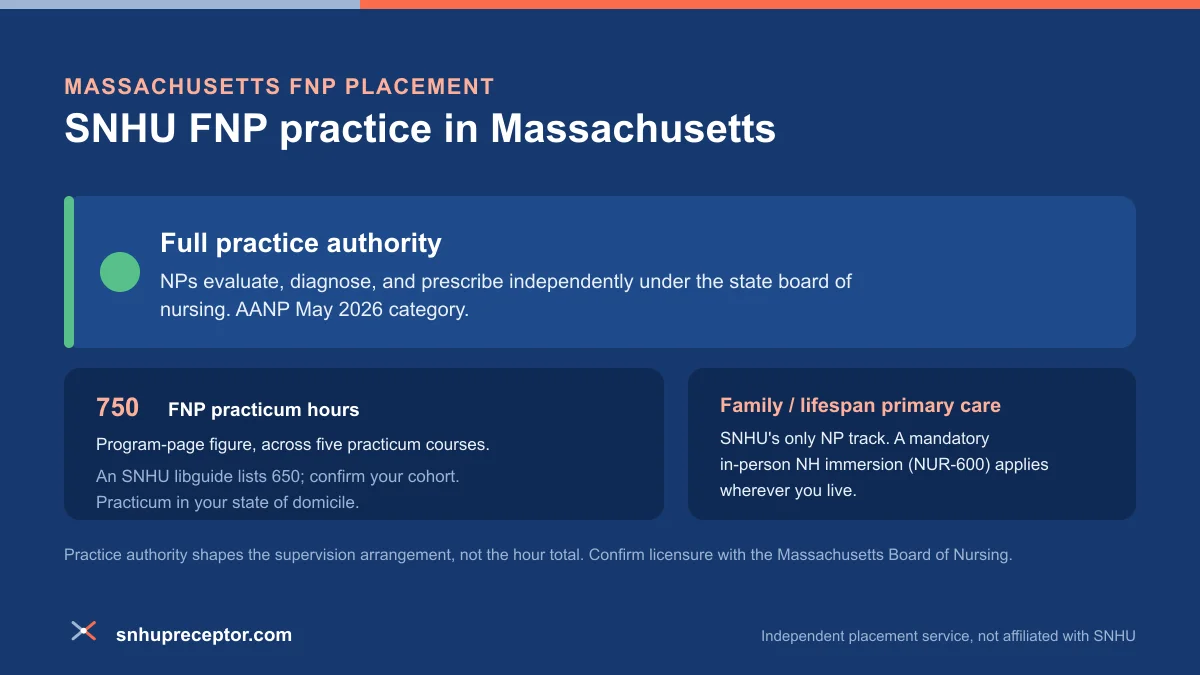
Full practice sets the professional context
AANP places Massachusetts in the full practice category. Within education, certification, competence, and state authority, a properly licensed nurse practitioner may evaluate patients, diagnose, order and interpret tests, manage treatment, and prescribe without a permanent physician collaboration requirement. That independence belongs to the licensed clinician. An SNHU student continues to practice under supervision and within the approved course and site plan.
The Massachusetts Board of Registration in Nursing is the official state source for nursing credentials. Check a prospective preceptor's legal name, active license, advanced practice role, population focus, and any public limitations. Professional directories and hospital biographies can help locate clinicians, but the Board record, employer authorization, and SNHU review each serve a different purpose.
Massachusetts FNP students must remain in their domicile state
SNHU currently includes Massachusetts among the states accepting FNP students. Its published rule also says FNP practicums must be completed in the student's state of domicile. A Massachusetts student should not plan clinical days at a Rhode Island, Connecticut, New Hampshire, or New York office simply because the commute appears manageable. Any residence or site change needs current written guidance from SNHU.
The FNP admission process asks an applicant to identify one potential preceptor for a clinical practicum. A suitable lead should work with the required primary-care population and have a physical Massachusetts organization willing to participate. The applicant's identification of a clinician does not complete the credential, site, schedule, compliance, or academic review.
Choose a Massachusetts market the student can attend consistently
Boston, Cambridge, and the inner suburbs contain extensive hospital, academic, outpatient, community, education, and administrative networks. High demand, centralized affiliation processes, parking, and travel time can make access more complicated than the number of organizations suggests. Students in Greater Boston should calculate the trip at the actual clinical hour rather than rely on off-peak mileage.
Worcester provides a major central Massachusetts hub. Lowell, Lawrence, Haverhill, and the Merrimack Valley open another northern corridor, while Brockton, Taunton, Fall River, and New Bedford may be more practical to the south. Springfield, Holyoke, Northampton, and Pittsfield support western searches with different health-system and community options.
Cape Cod and island students need an especially durable attendance plan. Seasonal traffic, ferry schedules, housing, and limited specialist availability can affect repeated visits. A site farther inland may offer more organizational depth, but only if the student can maintain the commute and the supervisor will be physically present for the required schedule.
FNP requirements extend beyond finding a clinician
SNHU publishes a minimum of 750 total FNP clinical hours under preceptor guidance across five courses. Use that total to discuss overall capacity, then follow the student's active academic plan for course dates and sequence. Do not create a conflicting per-course total from public descriptions.
The FNP pathway also requires an in-person immersion in New Hampshire through NUR 600 before the practicum sequence. The cross-border trip is separate from the Massachusetts clinical placement and does not alter the state-of-domicile rule. Because SNHU's public descriptions use different duration language, students should obtain current event details without assuming an exact number of days.
Nursing Education, Population Healthcare, Healthcare Quality and Safety, and Nurse Executive Leadership each publish a 135-hour final-course practicum. RN-to-BSN includes community-based clinical practice experiences with a qualified mentor, but no fixed public total applies to every student. SNHU offers no DNP and no nurse practitioner specialty other than FNP.
Massachusetts systems often require early coordination
A complete proposal identifies the organization's legal name and Massachusetts address, department, authorized student contact, preceptor credentials, patient or project population, dates, and weekly schedule. Large systems may require central review even when a clinician is enthusiastic. Ask the education or affiliation office how the request should move rather than sending duplicate forms to several employees.
Clinical organizations may request background checks, health documents, drug screening, professional liability coverage, and other onboarding materials. SNHU determines its own academic and documentation requirements. Complete each item through the correct process, keep sensitive records protected, and wait for written authorization before beginning the experience or counting time.
Physical placement and virtual review are not interchangeable
SNHU's published nursing information describes required clinical practice at an in-person location. It provides no general allowance for telehealth hours and names no universal clinical tracking system. The fact that academic instruction is online does not make the Massachusetts FNP clinical sequence or New Hampshire immersion remote.
We source potential physical placements throughout Massachusetts. We can assess a virtual-capable proposal only after current written permission from SNHU, the course team, the site, and every state tied to the activity. Assessment is not a promise of academic credit, and it cannot replace the FNP domicile requirement.
Ask for support with a defined Massachusetts search
Trusted by nursing students and working nurses. Our team can identify potential organizations and supervisors, check public credentials, and coordinate a proposed match for school and site review. Students pay only once a placement is secured, and current service details are available on the cost page.
Send the SNHU pathway, course, Massachusetts home base, clinical dates, work schedule, repeatable travel radius, and preferred physical setting through a free placement review. We will assess the regional options and explain which outstanding decision should be confirmed before the search advances.
Good to know
Is Massachusetts a full practice state for NPs?
Yes. AANP classifies Massachusetts as full practice. SNHU students still require supervision and approval for the specific course and site.
Can a Massachusetts resident currently study FNP at SNHU?
Yes. Massachusetts is on SNHU's current accepting-state list, and the FNP practicum must remain in the student's state of domicile.
What is the SNHU FNP clinical requirement?
SNHU publishes a minimum of 750 total clinical hours under preceptor guidance, plus a separate required in-person immersion in New Hampshire.
Can a Massachusetts proposal include virtual-capable activity?
Only after written permission from SNHU, the course team, the site, and every applicable state. No general telehealth-hour allowance is published.
Line up your preceptor, not your excuses
Tell us your track, your city, and your start timeline. We will come back with a placement plan and a realistic path to your preceptor, your cleared site, and your practicum hours.