Give us your track and your city. We come back with your preceptor path, free to ask and no obligation.
Shape an SNHU Nursing Experience Around Louisiana
Louisiana is a reduced practice state under AANP's current category, while SNHU does not currently list Louisiana among its FNP accepting states. Louisiana students in an eligible non-FNP nursing track should base their search on the course's real activities, a qualified supervisor, and a physical organization that can support the full term.
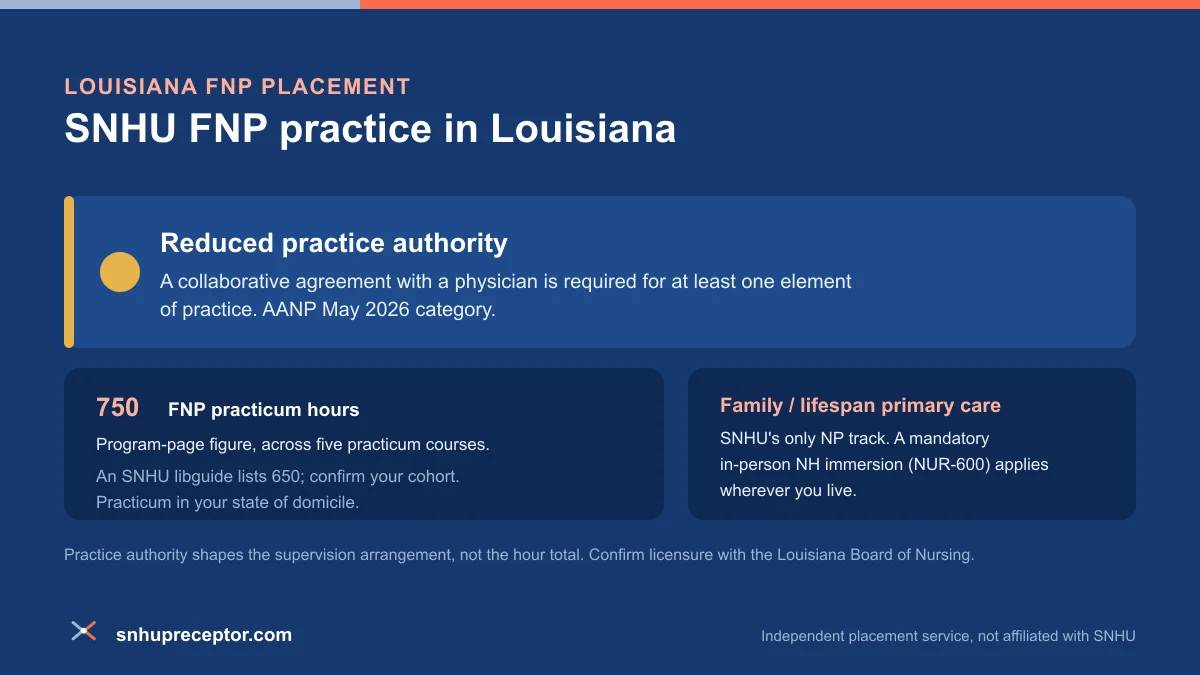
Louisiana practice rules shape the preceptor's work
AANP classifies Louisiana as reduced practice. This means state law reduces an NP's ability to perform at least one element of practice and requires a regulated collaborative arrangement for part of the clinician's work. A student may see that structure reflected in prescribing, clinic operations, consultation, or organizational policy. The category describes licensed professional practice, not independent authority for a graduate nursing student.
The Louisiana State Board of Nursing maintains the official nursing and APRN records. Verify the proposed supervisor's legal name, active credential, role, population focus, and any public limitations. A health-system biography or directory profile can reveal a promising lead, but it cannot replace the Board check or SNHU's evaluation of course fit and supervision.
FNP is not currently available to Louisiana residents
Louisiana is absent from SNHU's current list of states accepting students into the MSN Family Nurse Practitioner track. A resident should obtain new written eligibility direction from SNHU before asking a primary-care practice to hold clinical dates. Neither an active Louisiana license nor a willing preceptor changes the university's state authorization decision.
Eligible Louisiana students may instead be planning Nursing Education, Population Healthcare, Healthcare Quality and Safety, Nurse Executive Leadership, or RN-to-BSN work. These experiences have different objectives and may be supervised by educators, quality leaders, population health professionals, executives, or qualified mentors. Identify the exact track and course whenever an organization is contacted.
A Louisiana search works best in regional clusters
New Orleans and Jefferson Parish offer large health systems, community organizations, academic settings, and specialty departments. Baton Rouge adds state, public health, hospital, education, and administrative possibilities. Shreveport and Bossier City form the principal northwestern market, while Monroe can anchor a northeastern search.
Lafayette serves Acadiana, and Lake Charles provides another western Louisiana center. Alexandria is a practical midpoint for students in the central part of the state. Depending on the course, the Northshore, Houma, Thibodaux, Hammond, or smaller regional systems may be more realistic than a long commute to New Orleans or Baton Rouge.
Travel planning should include recurring attendance, bridge and traffic conditions, work obligations, and the organization's onboarding schedule. Coastal weather and operational interruptions can affect a term, so a student should understand the site's communication process and maintain enough calendar flexibility to follow SNHU's instructions if dates change. A nearby department is useful only when its work and supervisor align with the course.
Hour requirements depend on the SNHU pathway
SNHU publishes a minimum of 750 clinical hours for the FNP pathway under preceptor guidance across five courses. The pathway also includes an in-person immersion in New Hampshire before the clinical sequence. Those facts describe FNP, which is not currently available to Louisiana residents, and should not be copied into a non-FNP practicum plan.
Nursing Education, Population Healthcare, Healthcare Quality and Safety, and Nurse Executive Leadership each publish a 135-hour practicum in the final course. The RN-to-BSN program includes community-based clinical practice experiences with a qualified mentor, but SNHU does not state one fixed public hour total that applies to every RN-to-BSN student. Current course documents should guide the organization's capacity discussion.
SNHU offers FNP as its only nurse practitioner specialty and does not offer a DNP. Do not present a Louisiana PMHNP, AGACNP, DNP, or other unsupported track as an SNHU placement request. Students can use the clinical hours guide to separate the published requirements before preparing outreach.
Make the organization and supervisor easy to evaluate
A Louisiana candidate file should identify the legal organization, physical address, department, authorized contact, supervisor's credentials and job responsibilities, proposed activities, dates, and weekly schedule. For an education practicum, explain the balance of clinical and academic work. For quality, population health, or leadership, describe the project access and organizational authority the course requires.
SNHU notes that clinical organizations can require background checks, license verification, immunizations, drug screening, and professional liability coverage. Each participating site decides which onboarding steps apply, and the school determines what it needs for academic review. Keep those approvals distinct. An interested supervisor should not be given a start date until the organization and SNHU have completed their parts.
Treat in-person and virtual-capable plans differently
SNHU's public nursing information describes required clinical practice at an in-person location. It does not publish a general number of telehealth hours, a fully virtual nursing practicum route, or a named universal logging system. An online academic course can still contain physical field requirements.
We source potential physical placements across Louisiana for eligible SNHU tracks. We can conditionally examine a virtual-capable proposal only after written permission from SNHU, the course team, the site, and every state involved. The review does not promise that remote activity will be approved or count toward the course.
Bring local details to a Louisiana placement review
Trusted by nursing students and working nurses. Our team can identify organizations and supervisor candidates, check public credentials, and coordinate a potential Louisiana match for the required decisions. Pricing and service terms are kept on the cost page, separate from any school or site requirement.
Send the program, course, Louisiana city, dates, work schedule, travel range, and desired physical setting through a free placement review. We will assess the available regional search paths and flag any program, location, or format question that still requires written confirmation.
Good to know
Is Louisiana a reduced practice state?
Yes. AANP places Louisiana in its reduced practice category. Use the Louisiana State Board of Nursing for the current rules and credential record.
Does SNHU currently accept Louisiana residents into FNP?
No. Louisiana is not on SNHU's current FNP accepting-state list. Obtain new written eligibility guidance before pursuing an FNP placement.
How many hours do SNHU's non-FNP MSN tracks require?
Each of the four non-FNP MSN specializations publishes a 135-hour final-course practicum under preceptor guidance.
Can a Louisiana SNHU experience use a virtual-capable format?
Only with written permission from SNHU, the course team, the site, and every applicable state for the exact arrangement. No general remote allowance is published.
Line up your preceptor, not your excuses
Tell us your track, your city, and your start timeline. We will come back with a placement plan and a realistic path to your preceptor, your cleared site, and your practicum hours.