Give us your track and your city. We come back with your preceptor path, free to ask and no obligation.
Find the Right SNHU Practicum Setting in Connecticut
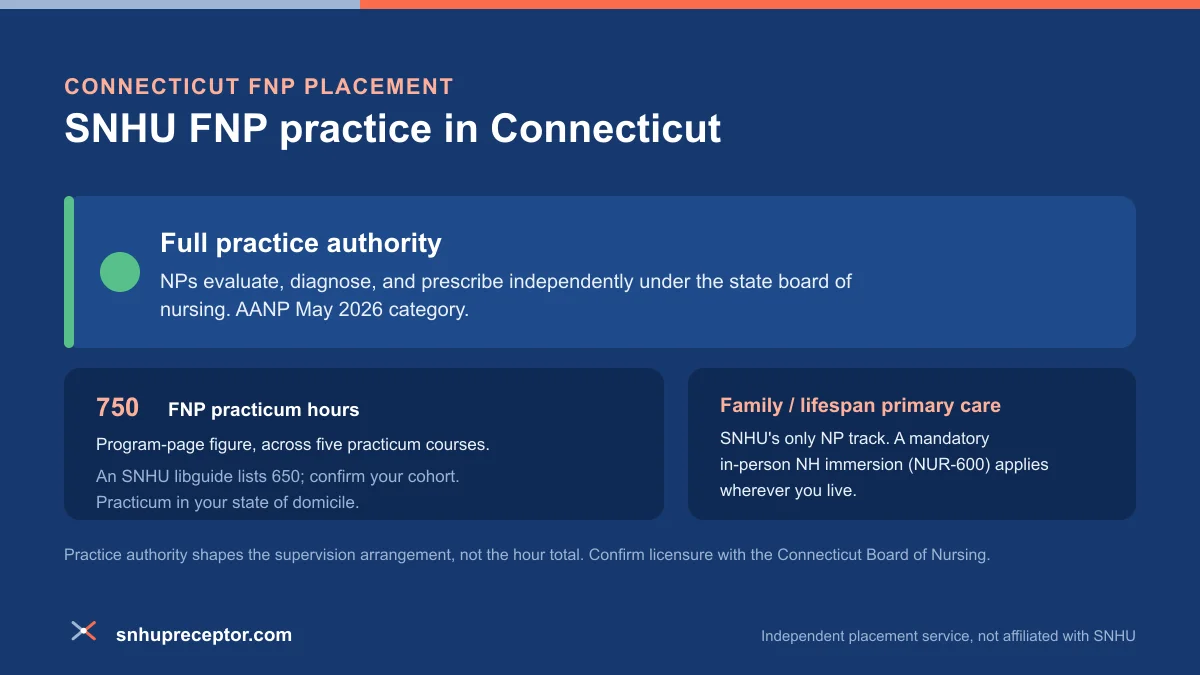
Connecticut is a Full Practice state and appears on SNHU's current list of states accepting FNP students. Eligibility opens the search, but the preceptor, organization, activities, and schedule still need review for the student's course.
Connecticut FNP students can move from eligibility to fit
SNHU currently accepts Connecticut residents into its MSN Family Nurse Practitioner track, subject to the university's active admission requirements. The state of domicile still matters. A Connecticut student who proposes a practicum in another state should ask SNHU how both locations affect eligibility, authorization, and site review before approaching a clinician there.
Admission is not the same as placement approval. The FNP applicant identifies one potential preceptor, and that person becomes a candidate for review rather than an automatic assignment. A useful first conversation covers primary care across the lifespan, the term calendar, anticipated weekly attendance, the population served, and the clinician's capacity to supervise. The organization must also agree to host the experience.
Full practice describes the preceptor's ordinary work
AANP lists Connecticut as a Full Practice state. A properly licensed nurse practitioner can evaluate patients, diagnose, order and interpret tests, manage treatment, and prescribe under Connecticut authority. That environment may allow a preceptor to demonstrate the broad work of primary care, but the student continues to practice under supervision and within the boundaries of the approved learning experience.
Use the Connecticut Board of Examiners for Nursing as the official licensing source. Check the prospective preceptor's legal name, active credential, role, population focus, and any public restrictions. Next, compare the professional's current work with SNHU's course expectations. A Board record establishes licensure; SNHU and the site decide whether the clinician, setting, activities, and supervision plan fit the practicum.
Plan all 750 FNP hours without inventing a breakdown
SNHU publishes a minimum of 750 practicum hours under preceptor guidance across five FNP practicum courses. The program prepares students for family primary care across the lifespan. Capacity should be discussed across the sequence, even when the immediate request is for one term. Confirm how many hours the current course requires from the student's academic materials instead of adding public course descriptions that do not reconcile to the published total.
The curriculum also requires an in-person New Hampshire immersion through NUR 600 before the practicum sequence. Connecticut makes that trip more manageable than many states, but it remains a distinct academic milestone and does not replace local clinical hours. Public SNHU descriptions vary on duration, so students should obtain current dates and travel instructions directly from the university rather than planning around a fixed day count.
Connecticut searches are local even in a compact state
Hartford and New Haven provide large health systems, outpatient networks, community clinics, academic settings, and administrative departments. Stamford and Bridgeport connect students to Fairfield County organizations, while Waterbury, New Britain, Norwich, and Danbury add regional choices. Crossing the state may look easy on a map, but rush-hour traffic and a long clinical day can make repeated attendance difficult.
Define a dependable travel corridor before sending requests. Rank FNP prospects by patient population, primary care fit, preceptor presence, schedule, and onboarding lead time. For non-NP MSN practica, identify departments that own education, quality improvement, population health, or executive work. A targeted note to the correct leader is more useful than a generic request sent to every practice in a city.
Other SNHU nursing tracks follow their own rules
Nursing Education, Population Healthcare, Healthcare Quality & Safety, and Nurse Executive Leadership each publish 135 practicum hours under preceptor guidance in the final course. Nursing Education splits its time between clinical and academic environments. SNHU's RN-to-BSN includes community clinical practice experiences with a qualified mentor, but the school does not publish a single total that applies to every Connecticut student.
A physical site file should name the organization, street address, department, authorized contact, supervisor, dates, weekly schedule, and patient or project population. SNHU lists possible requirements such as background checks, license verification, immunizations, drug screening, and professional liability coverage. FNP students also carry individual malpractice insurance during practicum courses and provide proof at least two terms before clinical components. SNHU has no DNP and no NP specialty beyond FNP.
Keep remote ideas behind written permission
SNHU's official nursing copy describes clinical practice hours at an in-person location. It does not publish a blanket telehealth allowance or a fully virtual FNP preceptorship. We source physical Connecticut prospects. We may review a virtual-capable proposal only after current written permission from SNHU, the course, the site, and each relevant state defines supervision and what may receive credit. Virtual capability alone never makes an hour countable.
Our role can include identifying suitable prospects, checking public licenses, clarifying the outreach brief, and gathering information for review. The preceptor and site remain proposed until their own participation decision and SNHU's academic decision are complete. Students see the proposed match before payment and pay only when a placement is secured.
Trusted by nursing students and working nurses. Send the track, course, Connecticut location, target term, availability, travel range, setting needs, and preferred physical or conditionally reviewed virtual format through a free placement review. We will assess the request and flag the confirmations that should be settled first.
Good to know
Does SNHU accept Connecticut residents into its FNP track?
Yes. Connecticut appears on SNHU's current accepting-state list for FNP. The proposed preceptor, physical site, activities, and schedule still require the applicable reviews.
What does full practice mean in Connecticut?
AANP's category means licensed Connecticut NPs have full practice authority under state licensure. Students remain supervised and receive credit only for experiences accepted for their SNHU course.
How many clinical hours does SNHU FNP publish?
SNHU publishes a minimum of 750 practicum hours across five FNP practicum courses. Use the student's current course materials for term details instead of building a total from inconsistent public course descriptions.
Are virtual FNP hours automatically accepted in Connecticut?
No. SNHU presents in-person clinical practice as the baseline. A virtual-capable arrangement needs prior written SNHU, course, site, and state permission before anyone treats its activities as academic credit.
Line up your preceptor, not your excuses
Tell us your track, your city, and your start timeline. We will come back with a placement plan and a realistic path to your preceptor, your cleared site, and your practicum hours.